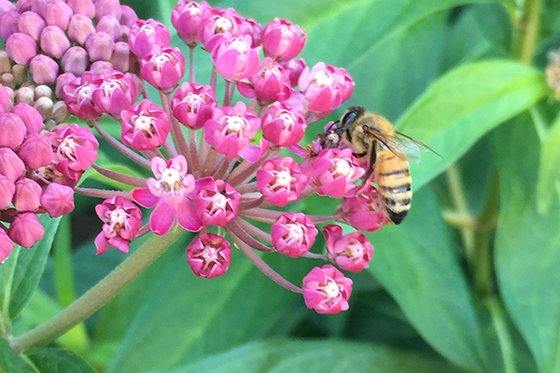
We're committed to supporting the local honey bee population and educating our community about the importance of bees.
Name a Honey Bee
You can “bee” involved! Help us reach our goal of naming 100 bees. Through our Name a Honey Bee Campaign, you can help keep our honey bees buzzing at Long Island Children's Museum. Join the effort to preserve the beehive by “bee”ing a part of the movement. Make your donation today to have your name featured on our All About Bees webpage and a personalized sign including your bee’s name on display in The Hive studio behind Feasts for Beasts. “Bee”low you can view our Name a Honey Bee Donors! Join the list today!
The Feasts for Beasts gallery features a large indoor observation beehive, home to more than 20,000 bees. The observation hive is housed between large sheets of plexi-glass where we can watch the bees hard at work building combs, filling them with honey and tending to the Queen. The space is illuminated with red light to enable viewing with minimal impact on the bees' natural behavior. The bees can come and go at will through a tube connecting the hive to the outside world.

Through the observational hive, visitors learn how bees collect pollen, make honey and that honey bees are responsible for some of our favorite foods.
Honey bees are vital to our ecosystem and our food supply. Unfortunately, the honey bee population is decreasing rapidly worldwide due to a serious threat called colony collapse disorder. Without enough honey bees, our fruit and vegetable crops will disappear! We can help these important creatures through education and supporting bee colonies.
Did you know?
- Through pollination, honey bees help local gardens grow flowers, fruits and vegetables.
- Honey bees have five eyes, four wings, six legs, and two stomachs (one for food, one for nectar).
- Honey bees pollinate some of Long Island’s most abundant crops including melons, pumpkins, tree nuts and berries.
- Many farms all over the country would not be able to survive without honey bees and we would lose some of our favorite foods such as cherries, apples and almonds.
What can you do?
- Plant wildflowers in your own backyard.
- Avoid pesticides and chemicals to treat your lawn – they will get into the nectar and pollen which can harm the bees.
- Consider buying honey from ethically sourced suppliers.
- Participate in LICM's Name a Honey Bee Campaign!
Thank you to our Name a Honey Bee Donors!
2025 Donors as of 8/20/25
Mark Aquino
Lisa Arp
Sabine Beccia
Anastasiia Becker
Jacob Biren
Scott Briskin
Herbert Buchsbaum
Alejandra Calemme
J.D. Chiu
Geeta Citygirl-Chopra
Melanie Corcoran
Clare Crotty
Lily D'Angelo
Katie Farkas
Muse Feldman
Catherine Fischer
Brian Frazier
Sara Hill
Priscilla Ihenacho
Bernadette Joe
Luke Kaminsky
Natalie Kessler
Aleisha Khan
Spencer Khan
Stanley Ko
Linda
Charlotte Ma
Kyle Mahoney
Genevieve Mandato-Greco
Josephine Mandato-Greco
Jeremy Metz
John Murphy
Madeline Murphy
Anika Canas Nagy
Audrey O'Malley
Danielle Pekalski
Claudia Perez
Margaret Pietroburgo
Justina Rhoads
A.J. Rhodes
Noa Robbins
Matthew Sanchez
Becca Schaeffer
Elijah Schulman
Stephanie Siler
Davv Siryeet
Eliana Thomas
Melissa Trepeta
Angela Vouvoudakis
Ben Wagman
Birdie Walsh
Sara Wenger
Nyrekia White
Amy Wynne
June Wynne